
| |
exploring the construction |
The fundamental nature of social risk merits rethinking given the pervasive impact of social media technology, conversational computing and generative algorithms. [1] This website describes our work exploring the potential value added to social risk management with key perspectives borrowed from the Social Sciences.
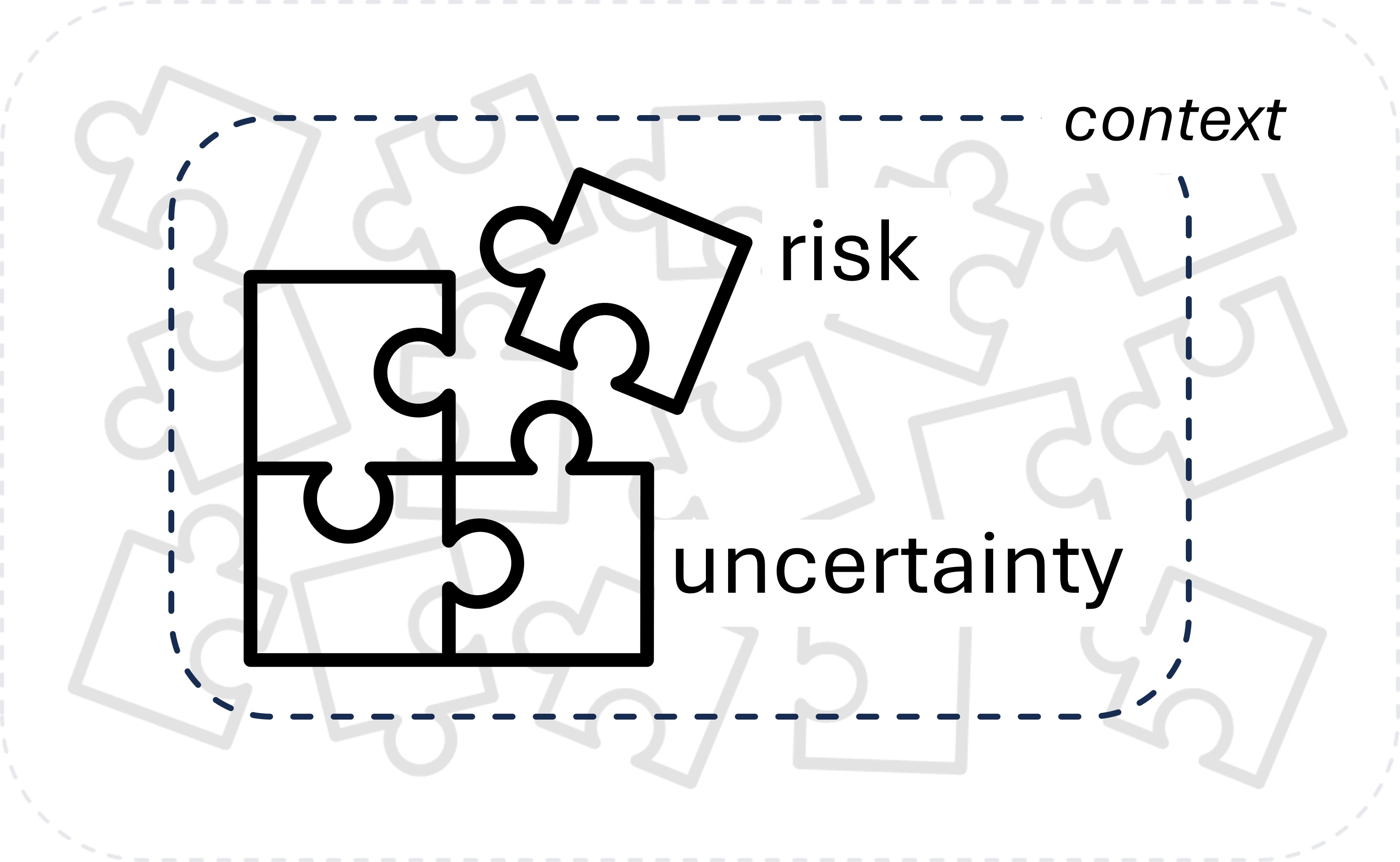
We look at risk identification as a social construct, focusing attention on the planner and their predictions. Uncertainty, as the feeling of doubt in a prediction, arises naturally in any social context. Risk, as a subjective invention, fulfills the prediction like a missing puzzle piece.
A broker has little to offer an uncertain stock market sensing something might happen, but a market characterized with a 10% risk of dropping 20% is focused and active. |
 |
Risk is constructed with predictions, with expectations of risk-events that might happen. The problem is- there is no limit to the number of such events. To address this, we explore an additional step, from behaviour to belief, [2] reaching beyond unlimited possible events to the belief systems directing behaviour. The goal is to provide strategists and risk managers with tools to test their plans for robustness against social risk and deception.
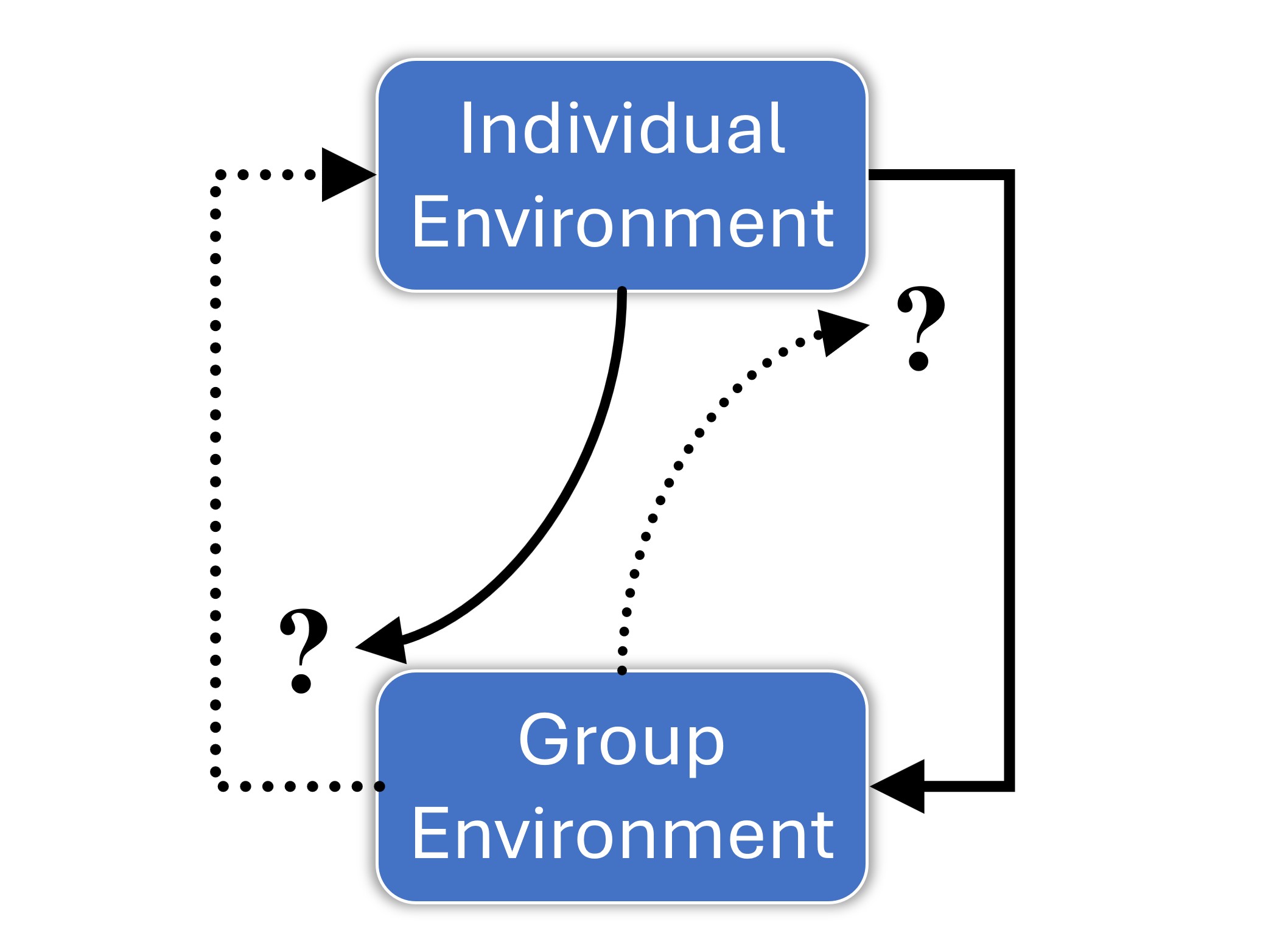
Social involves individuals and groups of individuals. Being social involves communication and feedback, sending and receiving messages. Individuals have their own interpretation of messages- what they mean and how to respond. [3] All of which results in some level of uncertainty, the irritation of doubt. For a sender, uncertainty is about the response to their message or action; will they be successful? Misunderstood or misjudged? For the receiver, uncertainty is about the message received; what was really meant? Is the message fake or deceptive? Has the context been tampered with? [4]
Communication involves communicating signs, symbols such as a word, gesture or action whose meaning is arbitrary and learned by each individual. [5] |
 |
The interpretation of communication is based on beliefs hidden to the receiver. Risk emerges naturally, inevitably as part of human behaviour. Just as someone learning to fit into a social group risks rejection, a company marketing a new product risks its reputation.To be social is to risk.
The focus of social risk herein is the subjective risk of groups forming and doing real things, such as ruining brand reputation, but only because of commonly held individual beliefs. [6]
The number of possible risk predictions at any point is limitless; what else could happen?. By asking why anything untoward might happen, stepping into the belief system(s) that resulted in the behaviour, a more stable structure is exposed that is closer to the root cause of many risk events. [7]
Whilst the relationship between belief and behaviour is complex, the planner and risk manager are fundamentally interested in simpler questions; do they think like us? Do they think like we think they do? Prediction then is not of events, but differences in belief systems.
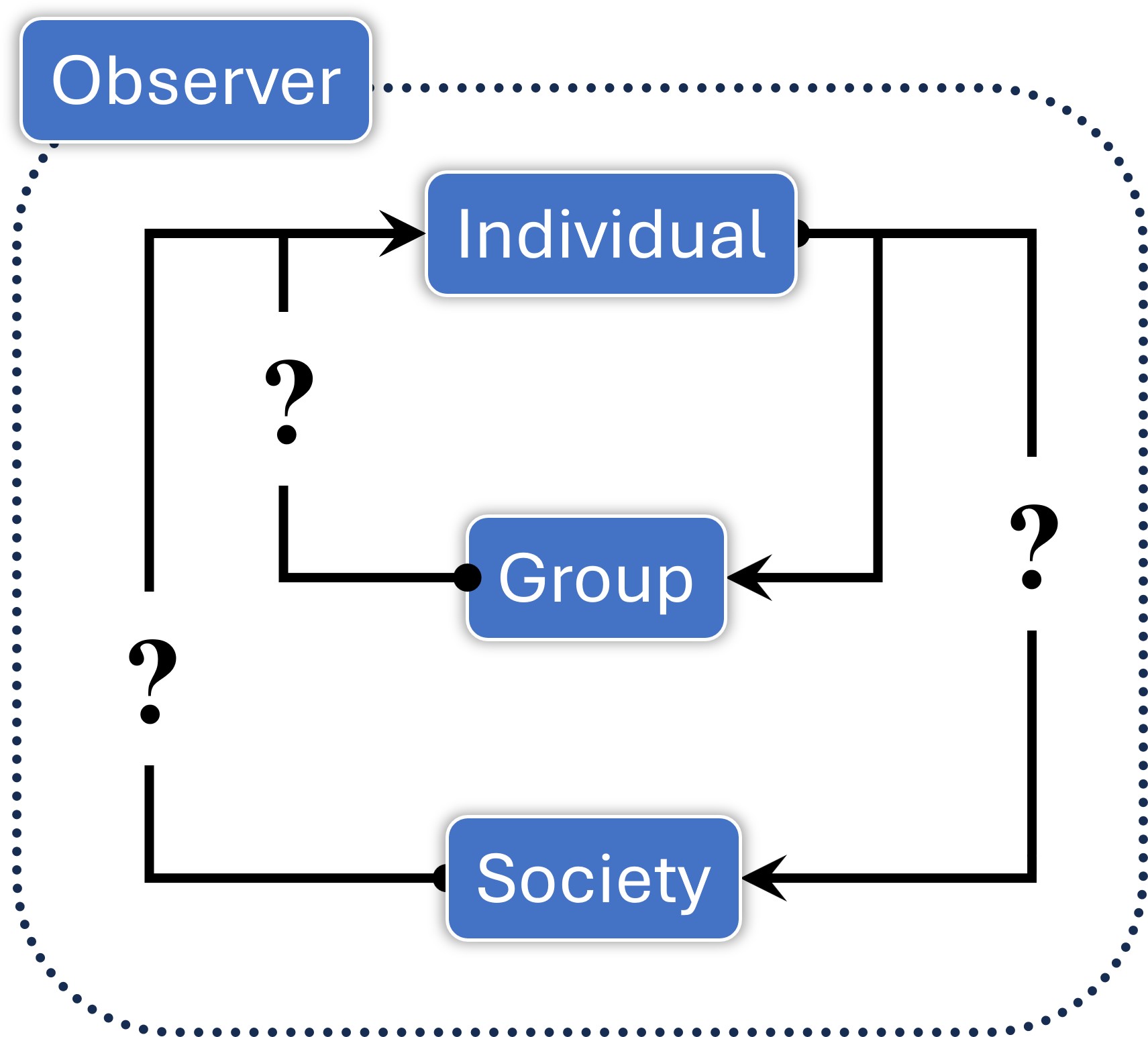
The mental model of a planner, as observer, becomes a communication road map, a system diagram to identify points of potential difference, points of communication between any two groups. It may be simple or very complex especially when augmented with technology.
Misprediction presents at any point. [8] For example, a risk engineer (Observer) might identify 3 points of concern: in product design from a designer (individual); in design review from a external consultancy (Group); with popularity of the product in the market (Society). |
 |
Estimating the underlying belief system would be a complex task. However, we intuitively sense potential alignment or the possibility of some kind of disruption [9]. Our focus here is to explore the value of framing social risk as the difference between the beliefs of two groups, between for example, the beliefs that direct an organization's design thinking and those of their customer.
Traditional scenario-based risk identification provides an event-based structure where scenarios are defined by major objective trends in the environment. This helps to reduce a unlimited number of possibilities to something more useful and manageable. Semiotic scenarios attempt to go deeper by following sign posts of difference.
Semiotic scenarios estimate the compatibility of belief systems, which then can be used to test the robustness of critical assumptions and to plan mitigation strategies aimed at reducing the misalignment. They provide additional, more enduring insight into unspecified emergence of untoward events/trends; a deeper structure within which to think about the future. More ...
Communication in natural language provides a unique opportunity to estimate the beliefs upon which a text is constructed with words. Discourse reduces complex mental activity to a word stream available for analysis.
The meaning of a message in natural language is to be found in the relative distribution of words and the contexts in which it was constructed then interpreted. To the extent such distributions represent their constitutive belief systems, a comparison of word distributions is a differential measure of beliefs that enhances the utility of semiotic scenarios.[10] As a step towards a useful implementation of this concept, we are exploring semiotic signatures to characterize belief systems.
We are also exploring semiotic difference as a proxy for a particularly insidious kind of deceptive persuasion based on context. Context is a major factor in meaning-making, thereby providing a semiotic lever with which a message can be deceptive; it also provides the means to detect such behaviour. More ...
|
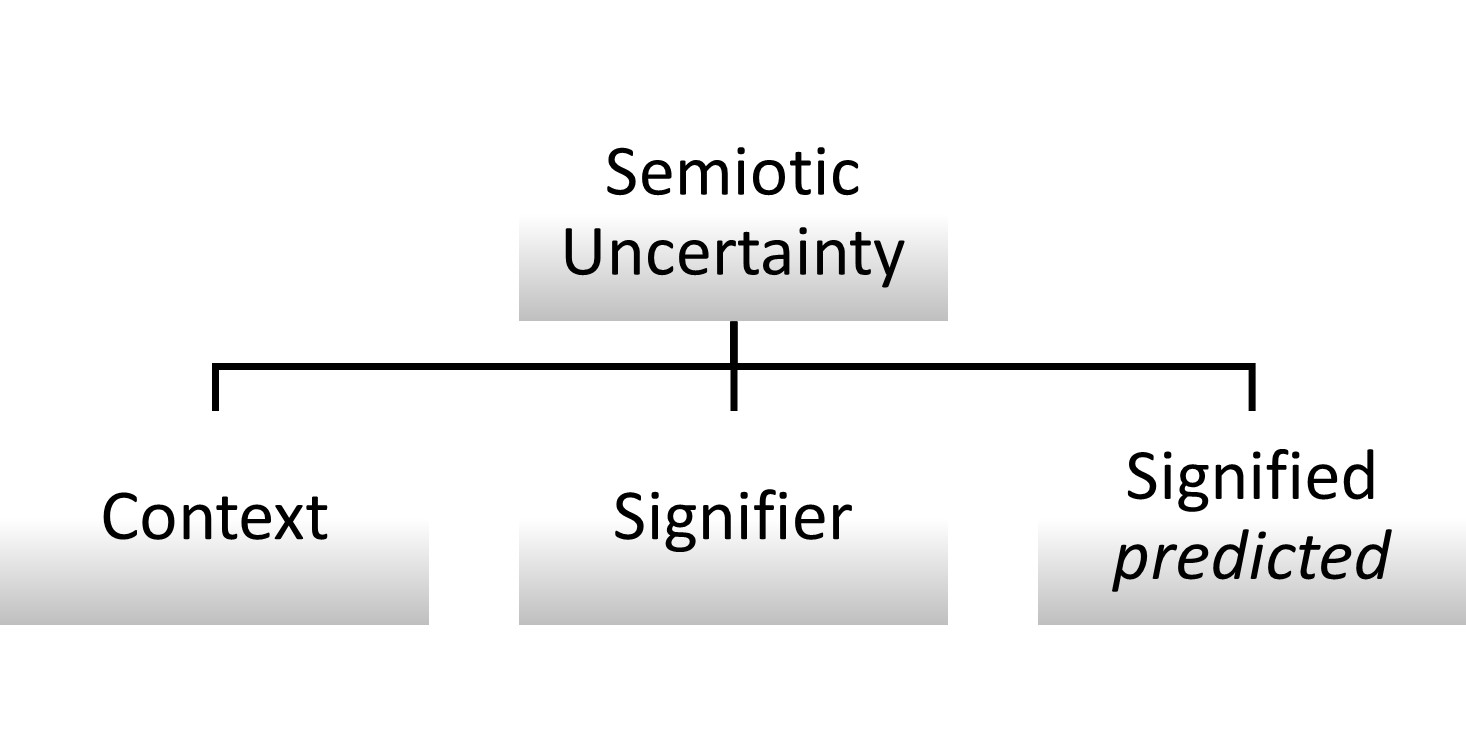
Three accessible elements in semiotic communication: external context, signifier and professed signified; each a natural source of uncertainty and opportunity for deception. |
 |